Origin of Open Source
Origins of FOSS: Unix
Origins of FOSS: Unix
Note: Cited from For Fun and Profit: A History of Free and Open Source Software Revolution by Christopher Tozzi.
In this context, Unix refers to the operating system built at AT&T's Bell Laboratories beginning in 1969. Although Unix is technically not considered Free or open source, it's first 15 years birthed many practices that greatly influenced Free and Open Source (FOSS) Software through its early developers.
Starting a research project, Unix was collaboratively developed and freely shared among programmers at a number of different locations. It conceptualized itself as a rebel force against the encroaching business interests in the computer world.
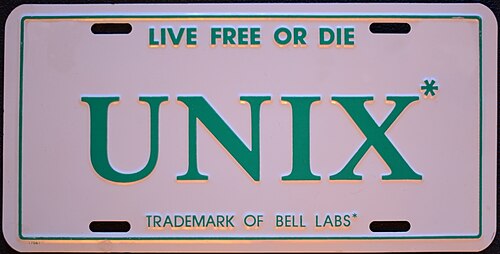
This sentiment solidified after AT&T started to sell Unix as a commercial product in the early 1980s. The high point of this reflected values researchers have called the hacker ethic.
The photo above shows license plates modeled off of Rhode Island's displaying: “Live Free or Die: Unix. These were distributed by Armando Stettner of Digital Equipment Corporation (DEC).
Origins of FOSS: Hacker Ethics
Origins of FOSS: Hacker Ethics
The hacker ethic has roots that predate FOSS, but it shaped how FOSS projects were developed and how its users and developers think about software in its political, social, and economic significance. In this context, hacker refers to a broadly defined group of programmers committed to to creativity, exploration, collaboration, and transparency in the use of computers.
Hacker ethics published by journalist Steven Levy in 1984 in Hackers: Heroes of the Computer Revolution
-
“Access to computers—and anything that might teach you some- thing about the way the world works—should be unlimited and total.”
-
“All information should be free.”
-
“Mistrust Authority—Promote Decentralization.”
-
“Hackers should be judged by their hacking, not bogus criteria such as degrees, age, race, or position.”
-
“You can create art and beauty on a computer.”
-
“Computers can change your life for the better.”
Challenges for Hackers
Challenges for Hackers
In the 1980's, developers noticed a troubling trend, where the software industry was gravitating towards creating proprietary software and commercialization. Although many hackers were not against all forms of commercialization (i.e support for software development), but did not support the practice of making a profit by selling software for purely commercial means.
Another practice that caused challenges at the time was distributing software only in binary form, without source code. While binary software could run on any computer, because it lacked human-readable source code, it was difficult for people to modify them or study how they worked, making the software closed source.
The lack of access caused issues ecause if the developers noticed a bug in the software they were using, it was impossible for them to fix it themselves. They would have to wait for the company that created it to release a new version, which could take months or years. The second one was, if the company that created the software went out of business, the developers would either be stuck with old software, or have to buy new one from a different company.
Free Software Movement
Free Software Movement
There were 3 responses to the commcercialization and closing of software:
-
First, programmers at the University of California, Berkeley, eventually created a Unix clone that was free of commercially licensed code and suited the needs of many hackers.
-
Another way that hackers confronted the threats they faced from commercialization and closed source software in the 1980s emanated from the Open Software Foundation. The Open Software Foundation sought to forestall that eventuality by promoting a set of software standards across Unix versions. The standards would ensure that Unix programs remained compatible between different platforms and variants of the operating system.
-
The third major response of hackers to the threats from commercialization and closed source software that they faced in the 1980s—and the one that proved to be the most enduringly important for the history of FOSS—was the GNU project, which Stallman announced in 1983 and launched in early 1984.
Richard Stallman is one notable developer of the "Free Software" movement. After facing some of the challenges described above while he was a programmer at the Artificial Lab at MIT in the 1970s and 1980s, Stallman created the concept of "free software" to gather a programming community that would discuss and improve on software together. Currently, he is the founder of the Free Software Foundation.
The "free software movement" laid the groundwork for what we now know as the "open source" movement.
Origins of the Term "Open Source"
Origins of the Term "Open Source"
In late 1997 and very early 1998, some community members desired to transition from the name "free software", because the "free" in its title kept being misconstrued as free to use, not free as in speech.
During this time, Christine Peterson (pictured below) of the Foresight Institute pitched the name "open source", which eventually became a widely used term. You can read Christine's account of how she created the term.

FLOSS Software
FLOSS Software

FLOSS is an acronym for Free, Libre, Open-Source Software. Despite the Open Source and Free Software movements sharing similar communities and origins, their differences in fundamental ideas cause many people in the Free Software community to argue with those who promote Open Source software.
'The acronym FLOSS is sometimes used to bridge the communities and their differing opinions. The word libre is added to free to make the goal of "free as in freedom", the ideals of liberty, more clear.' - Casey Reas